
Last updated: June 2026. This article is reviewed quarterly.
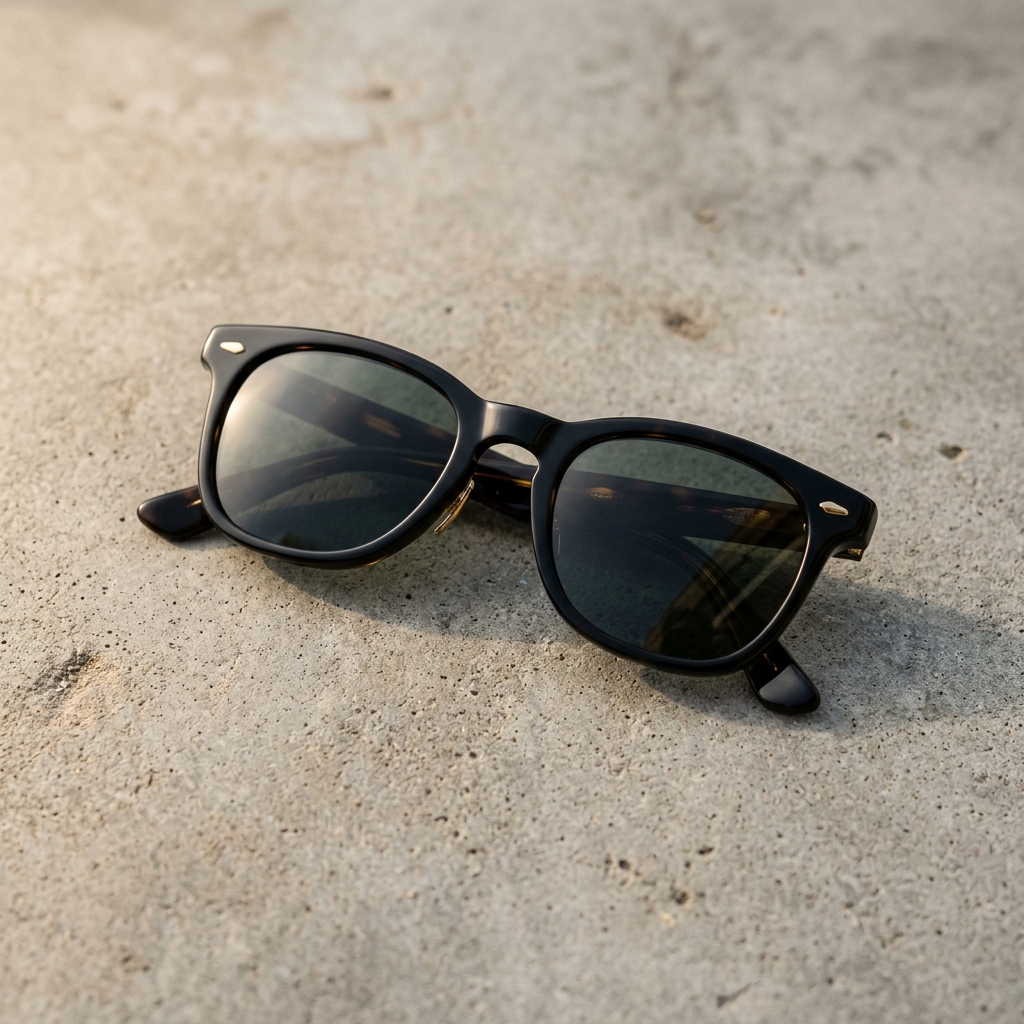
If you are currently wearing a pair of Ray-Bans, Oakleys, or Prada frames, take them off and look at the inner temple. The tiny stamp saying “Made in Italy” is the most expensive piece of marketing you will ever purchase.
For years, consumers have accepted that paying $200 to $400 for a pair of branded sunglasses is the price of quality. We tell ourselves that the premium price buys superior optics, handmade craftsmanship, and advanced frame materials that cheap gas-station alternatives cannot replicate.
A decade ago, I ran a small independent boutique and believed the same. I spent hours memorizing brand catalogs, talking to sales representatives, and justifying the high prices to my customers. Then, a veteran frame-maker from a family-run factory in Japan showed me how the products were actually put together. That afternoon shattered the luxury illusion for me.
—
The Material Truth of Injection-Molded Plastic
The retail price of sunglasses has almost no correlation with the cost of the raw materials inside them.
The vast majority of mid-tier designer sunglasses on the market are made of injection-molded polycarbonate or cheap grilamid plastic. To make these frames, factories heat liquid plastic pellets and squirt them into a pre-designed steel mold. A single machine can pump out 120 of these raw frames every single minute. The cost to produce one of these frames at scale is less than $1.50 in raw materials and machine energy.
Contrast this with true premium eyewear, which uses cellulose acetate.
Cellulose acetate is a plant-based plastic derived from wood pulp and cotton fibers. Producing an acetate frame is a slow, multi-week process:
* Sheet Curing: Raw cotton pulp is dyed, pressed into thick blocks, and sliced into flat sheets that must cure for weeks to prevent warping.
* CNC Milling: The frame shapes are slowly cut out of the cured sheets using high-precision CNC routers.
* Tumble Polishing: The rough frame fronts are placed inside large wooden barrels filled with birch wood chips and pumice powder. The barrels spin continuously for 48 hours to smooth down the edges.
* Hand Finishing: Skilled workers use buffing wheels to polish the plastic until it achieves a deep, glassy shine that injection-molded plastic can never match.
Even for high-end cellulose acetate frames, the manufacturing cost at the factory level rarely exceeds $12 to $18. This includes real riveted metal hinges and standard polarized lenses.
When you pay $250 for a pair of sunglasses, you are not buying $200 worth of premium engineering. You are buying a $10 product with a $240 markup.
—
The Luxottica Loop: The Illusion of Choice
How does a $15 product successfully retail for $300 across the globe without anyone questioning it?
The answer lies in a single Italian conglomerate based in Milan: EssilorLuxottica.
Most people believe they are participating in a highly competitive market when they shop for eyewear. They walk into a store, look at a wall of Ray-Bans, compare them to a sporty pair of Oakleys, and then browse the luxury racks to try on Chanel, Prada, or Coach. They think they are choosing between fierce competitors.
In reality, every single one of those brands is owned, licensed, manufactured, and distributed by EssilorLuxottica.
This corporate structure is one of the most successful vertical monopolies in modern business history. To understand how they control the prices we pay, we must examine the four pillars of their retail loop:
1. Proprietary Brands: They own Ray-Ban, Oakley, Persol, Oliver Peoples, and Alain Mikli outright.
2. Luxury Licenses: They hold the exclusive rights to design, manufacture, and distribute eyewear for Prada, Chanel, Giorgio Armani, Versace, Burberry, Coach, Tory Burch, and Michael Kors.
3. Retail Dominance: They own the stores where you buy these glasses, including Sunglass Hut, LensCrafters, Pearle Vision, and Target Optical.
4. Insurance Control: They own EyeMed, the second-largest vision insurance provider in the United States, which determines which doctors and frames are covered for millions of patients.
This closed-loop monopoly is the engine behind the price tags. If an independent brand tries to sell high-quality frames for $80, EssilorLuxottica can simply deny them shelf space in Sunglass Hut or limit their insurance coverage via EyeMed.
“Luxottica is the classic illusion of choice. You go into Sunglass Hut, look at Ray-Bans, Oakleys, and Persols, think you’re choosing between different competing brands, but every single dollar you spend goes into the exact same Italian bank account.” — Reddit user, r/sunglasses
By controlling the design, the manufacturing, the retail shops, and the insurance companies, the conglomerate has decoupled the price of eyewear from the traditional laws of supply and demand. They charge $200 because they own the entire pipeline, and they know you have nowhere else to go.
—
Pierre Bourdieu and the Mechanics of Taste
The Luxottica monopoly explains the supply side, but it does not fully explain the demand. Why do we, as consumers, willingly cooperate in our own financial exploitation?
To understand our compliance, we must turn to French sociologist Pierre Bourdieu and his theory of Cultural Capital.
Bourdieu argued that in modern society, social class and power are not just maintained by wealth, but by taste, style, and aesthetic choices. What we consume signals our position in the social hierarchy.
Eyewear occupies a unique position in this system. Unlike a watch hidden under a sleeve or a brand label on the inside of a coat, sunglasses sit directly on the center of the human face. They are the first thing people notice during an interaction.
Because of this visual prominence, sunglasses have transitioned from a simple tool for UV protection into a highly efficient vehicle for social signaling:
* Aesthetic Distinction: By wearing a brand name like Chanel or Prada on your temples, you signal access to luxury culture and sophisticated taste.
* The In-Group Signal: A distinct, recognizable frame shape like the Ray-Ban Wayfarer tells the world you belong to a specific creative or professional class.
EssilorLuxottica understands this sociology perfectly. When they license a fashion brand name, they are not buying better materials or design techniques. They are buying the cultural capital associated with that fashion house.
They know that a consumer will gladly pay a 2,000% markup on a piece of plastic because they are not paying for the acetate. They are paying for the silent social validation that comes with wearing the brand on their face. The price is not a reflection of product quality; it is the fee we pay to participate in the game of social distinction.
—
How to Break the Loop: The Smart Buyer’s Guide
Breaking free from the monopoly does not mean you have to settle for cheap, ugly, gas-station sunglasses that distort your vision and scratch within a week.
Excellent eyewear exists. You simply have to look outside the corporate retail malls.
Here are the four key principles to finding high-quality frames without paying the corporate brand tax:

1. Demand Real Cellulose Acetate
Avoid any glasses described simply as “plastic,” “injection-molded,” or “polycarbonate” unless they are dedicated running or cycling glasses where impact resistance is the only priority. Look for brands that explicitly state they use “cellulose acetate” or “Mazzucchelli acetate” (the gold standard of Italian acetate manufacturing). Acetate has a richer color depth, feels warm to the touch, and can be heated and adjusted by an optician to fit your face perfectly.
2. Inspect the Hinge Construction
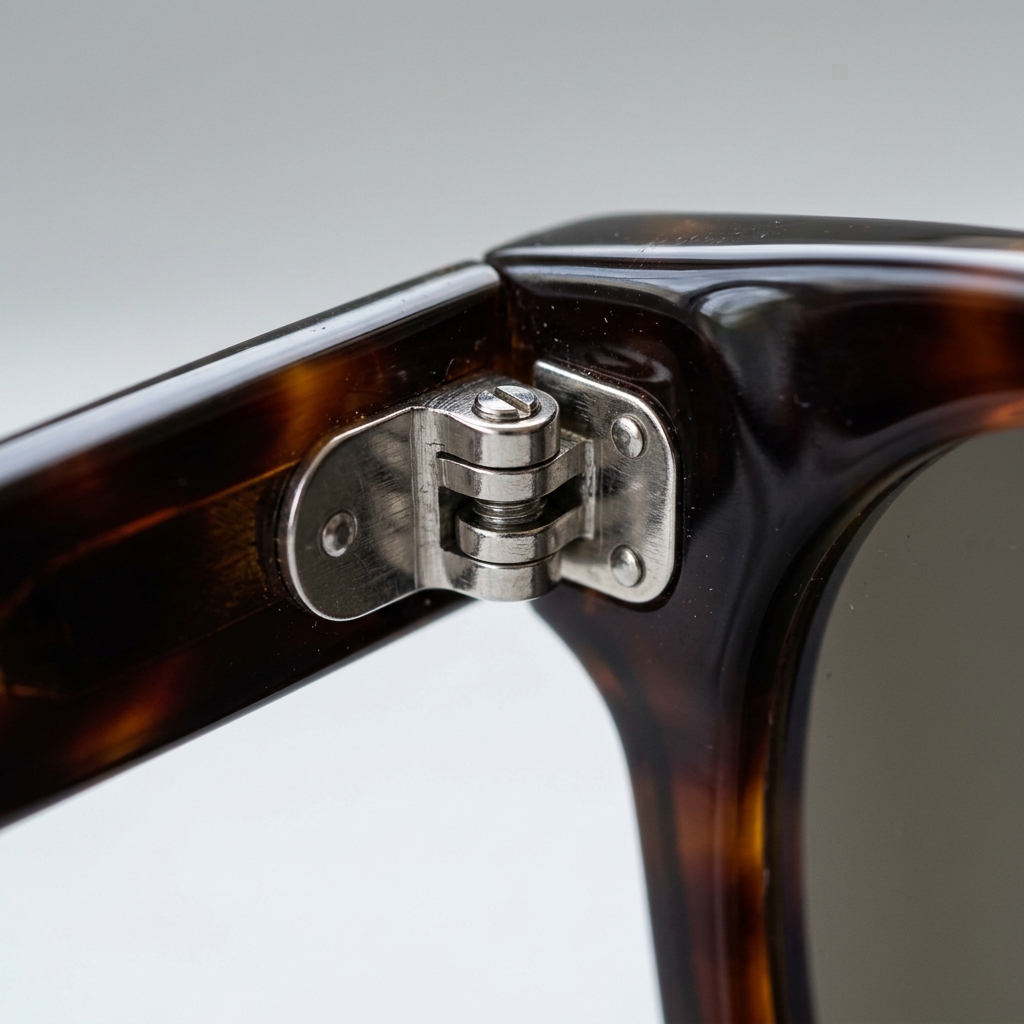
Cheap sunglasses use heat-pressed hinges, where the metal hinge is simply melted into the plastic temple. These break easily under stress. Quality frames use riveted hinges, which are physically pinned through the acetate using metal rivets that are visible on the front and sides of the frame. A seven-barrel or five-barrel riveted hinge represents serious, durable construction.
3. Choose Tempered Glass Lenses
Most designer sunglasses use nylon or polycarbonate lenses because they are cheap to produce and light. Nylon is decent, but nothing matches the clarity and scratch resistance of tempered mineral glass. Glass lenses do not degrade over time, are highly resistant to sand and keys in your pocket, and offer the sharpest optical alignment possible.
4. Support Independent Eyewear Specialists
Look for independent, designer-owned brands that design their frames in-house and work directly with small family-owned factories in Japan or Italy. Brands like Randolph Engineering (who still make frames for military pilots in Massachusetts), Garrett Leight, Shuron, or lifestyle accessory specialists like olive&piper design their products away from the corporate monopoly. By buying directly from them, your money pays for materials and craftsmanship rather than corporate licensing fees and retail mall leases.
—
A New Baseline for Eyewear
The next time you walk into a major optical chain, remember that the rows of shiny logos are an illusion. The differences between the $180 frame and the $380 frame are almost entirely commercial, not physical.
Opt out of the corporate loop. Look for independent craftspeople, demand real materials, and buy glasses that are built to last rather than designed to be replaced.
What is your experience with independent eyewear? Have you noticed a difference in build quality compared to major designer brands? Let us know in the comments below.
👉 Explore Our Curated Independent Accessories Collection — Handcrafted Quality Built to Last