
Disclosure: This article may contain affiliate links. If you buy through our links, we may earn a commission at no extra cost to you. Editorial opinions remain our own.
A black knit top can cost $19 in one store and $79 in another. From six feet away, both may look fine on the hanger. The gap starts to show after the second wash, the fifth wear, and the first time you expect the piece to hold its shape through a full day.
That is the real conversation. Fast fashion and mid-range brands are not separated by marketing language alone. They are separated by what each brand is trying to optimize.
Fast fashion is built to move quickly, catch a trend, and hit a price that feels easy to say yes to.
Mid-range brands are usually built to slow that process down a little, spend more on fabric and fit, and give you a better chance of wearing the piece again next season without regretting it.
If you want the shortest answer possible, here it is:
- buy fast fashion for short-term style experiments, one-off events, and low-risk trend pieces
- buy mid-range for wardrobe basics, tailoring-adjacent items, and anything you expect to wear often
That rule will not be perfect every time, but it will keep you out of most bad buys.
The Short Answer
Fast fashion usually wins on trend speed and entry price. Mid-range usually wins on fabric, fit consistency, finishing, and repeat wear value. A cheap item can still be useful, and an expensive one can still disappoint, but mid-range brands tend to give you a higher floor when you want clothes to hold up.
| Tier | Usually Delivers | Best For | Common Tradeoff |
|---|---|---|---|
| Fast fashion | Low upfront price, fast trend turnover, easy browsing | Occasional pieces, trend testing, event looks | Less consistency in fabric, fit, and long-term shape retention |
| Mid-range | Better materials, cleaner finishing, more reliable fit | Basics, workwear, denim, outerwear, repeat-use staples | Higher spend, and not every brand improves enough to justify it |
What Fast Fashion Actually Optimizes For
Fast fashion is not just “cheap clothing.” It is a speed-and-volume model. The system is designed to spot a look, produce a version quickly, and sell it before the trend cools off.
That model creates a few obvious strengths.
- Lower entry prices
- Fast response to trends
- Huge product assortment
- Easier impulse buying
For shoppers, that can be useful. If you want to test a color, a silhouette, or a current trend without committing much money, fast fashion can make sense.
It also works when the item does not need a long life. Vacation outfits, party tops, novelty pieces, and trend-led accessories often fall into that category.
The tradeoff is that speed pressures every part of the garment. Fabric choices get tighter. Sampling rounds get fewer. Quality control has less room. Finishing details that do not sell the piece on first glance are often where corners get cut.
That is why a fast-fashion piece can look surprisingly good on the rack, then start showing stress around the collar, side seams, waistband, or knees much sooner than you hoped.
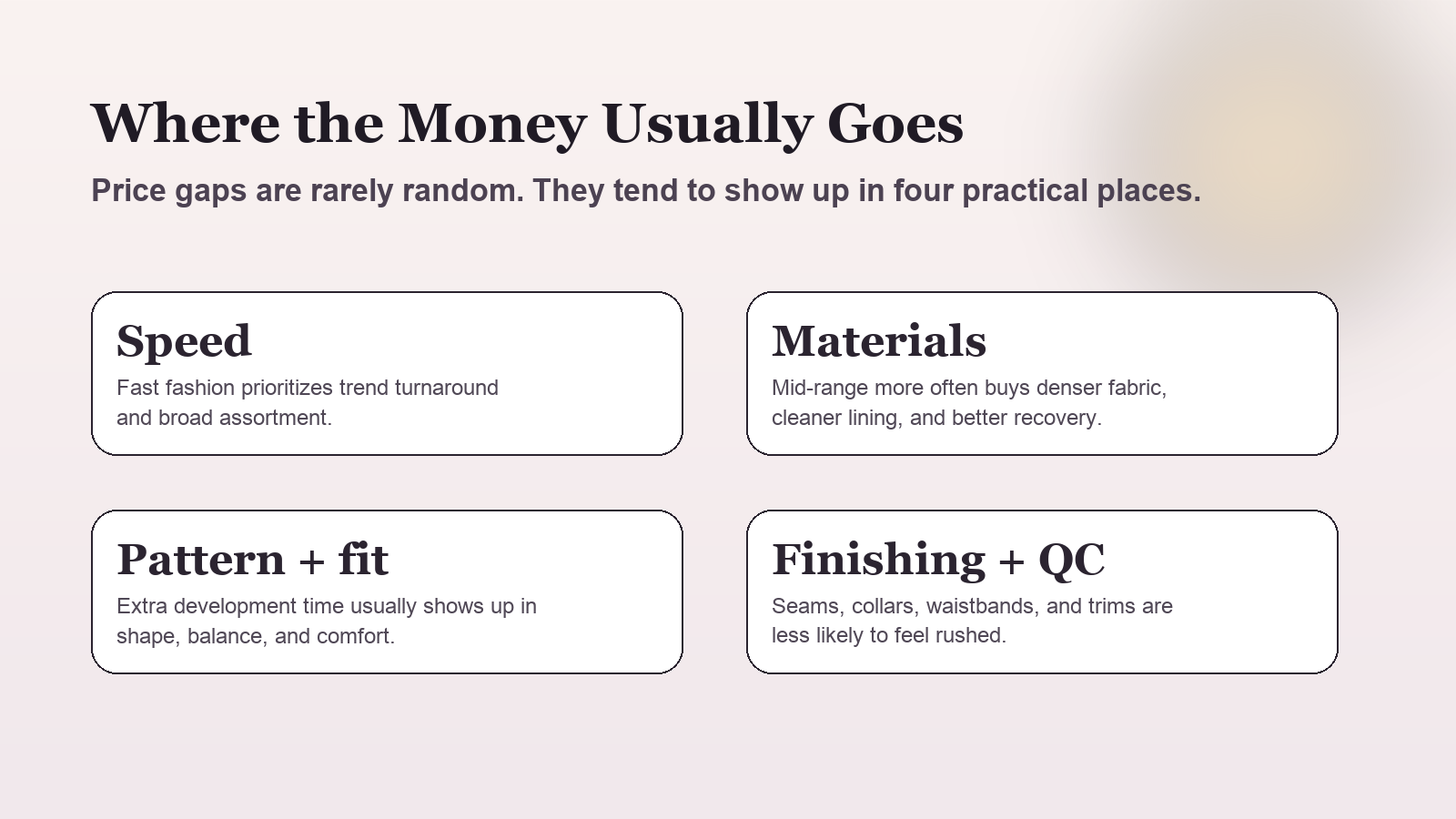
What Mid-Range Brands Usually Spend More Money On
Mid-range brands often sell fewer surprises. You are usually paying for a more stable product: better fabric selection, more consistent pattern work, and fewer obvious shortcuts in finishing.
That extra money often goes into a few places shoppers can actually feel.
Better Fabric Selection
Mid-range brands are more likely to use heavier jersey, denser poplin, cleaner knits, and linings that do not feel like an afterthought. You may not know the exact mill, but you can usually feel the difference in drape, opacity, and recovery.
More Thoughtful Pattern Making
This matters more than most people realize. A shirt can use decent fabric and still look off if the armhole, shoulder, rise, or leg line was simplified too aggressively. Mid-range pieces are more likely to sit better on the body because more attention went into the shape, not just the styling photo.
Cleaner Finishing
Look at hems, inside seams, button attachment, zipper behavior, pocket placement, and how the garment looks after being handled. That is where price differences often become easier to justify.
Lower Tolerance for Obvious Defects
No brand is perfect. Still, mid-range labels generally work harder to avoid the kind of puckering, twisting, thinness, or shape collapse that makes a piece feel cheap fast.
Why Mid-Range Often Feels Better on the Body
The biggest difference is not always durability. It is wear experience. Mid-range clothes often hang better, stay balanced longer, and require less “styling rescue” to look intentional.
This is why someone can try on two similar shirts and describe one as “just better” even before they know the price. The better shirt may have:
- a neckline that sits flatter
- sleeves that do not flare awkwardly
- fabric that skims instead of clings
- side seams that stay where they belong
Those details create calm. You stop tugging at the hem. You stop adjusting the shoulders. The piece does more of the work on its own.
That is especially noticeable in categories like:
- T-shirts and knit tops
- Trousers and denim
- Blazers and structured outerwear
- Dresses that need drape, not stiffness
This is also why mid-range basics can outperform cheaper trend pieces in actual wardrobe value. The item may cost more once, but it earns that price back by being easier to wear again and again.
Where the Price Gap Really Goes
Not every extra dollar goes into quality. Some of the gap is fabric, fit, and construction. Some of it is packaging, store overhead, marketing, and brand positioning.
That is where shoppers get understandably skeptical. They should.
There is no universal rule that says a $95 shirt is good and a $29 shirt is bad. Brand tax is real. Some labels charge more for mood, store design, and lifestyle signaling than for the garment itself.
Still, the broad pattern holds. When you move from fast fashion into a decent mid-range tier, you are more likely to get:
- better fabric weight
- cleaner stitching
- stronger shape retention
- less transparency
- more reliable sizing from piece to piece
The mistake is assuming the entire price jump is fake. The opposite mistake is assuming the entire price jump is earned. Good shopping lives between those two ideas.
When Fast Fashion Is the Smarter Buy
Fast fashion is not automatically a bad decision. It is often the smarter decision when the garment has a short style horizon, a low wear count, or a narrow role in your closet.
It makes sense when:
- you are testing a trend you may not like in six months
- you need a single-event outfit
- you want a color or silhouette experiment without spending much
- the item is more visual than technical
For example, a very current top, a vacation dinner dress, or a sharply seasonal party piece may not need the same long-term build quality as your everyday jeans or black trousers.
The key is honesty. Problems start when people expect a trend piece bought at speed to perform like a wardrobe staple bought for repetition.
When Mid-Range Is Worth Paying For
Mid-range pays off when the item has to carry your wardrobe, not just decorate it. The more often you plan to wear something, the more those quieter quality gains start to matter.
Spend more readily when you are buying:
- everyday T-shirts and knitwear
- denim you expect to keep for years
- trousers for work or travel
- coats, jackets, and blazers
- shoes or bags that need structural integrity
These are the pieces where shape retention, comfort, and finishing show up constantly. They also affect everything around them. A better tee makes cheap trousers look calmer. A better blazer makes a basic outfit look intentional.
That is why mid-range often feels less wasteful over time, even if the receipt hurts more on day one.
A Simple Shopping Checklist That Works in Any Store
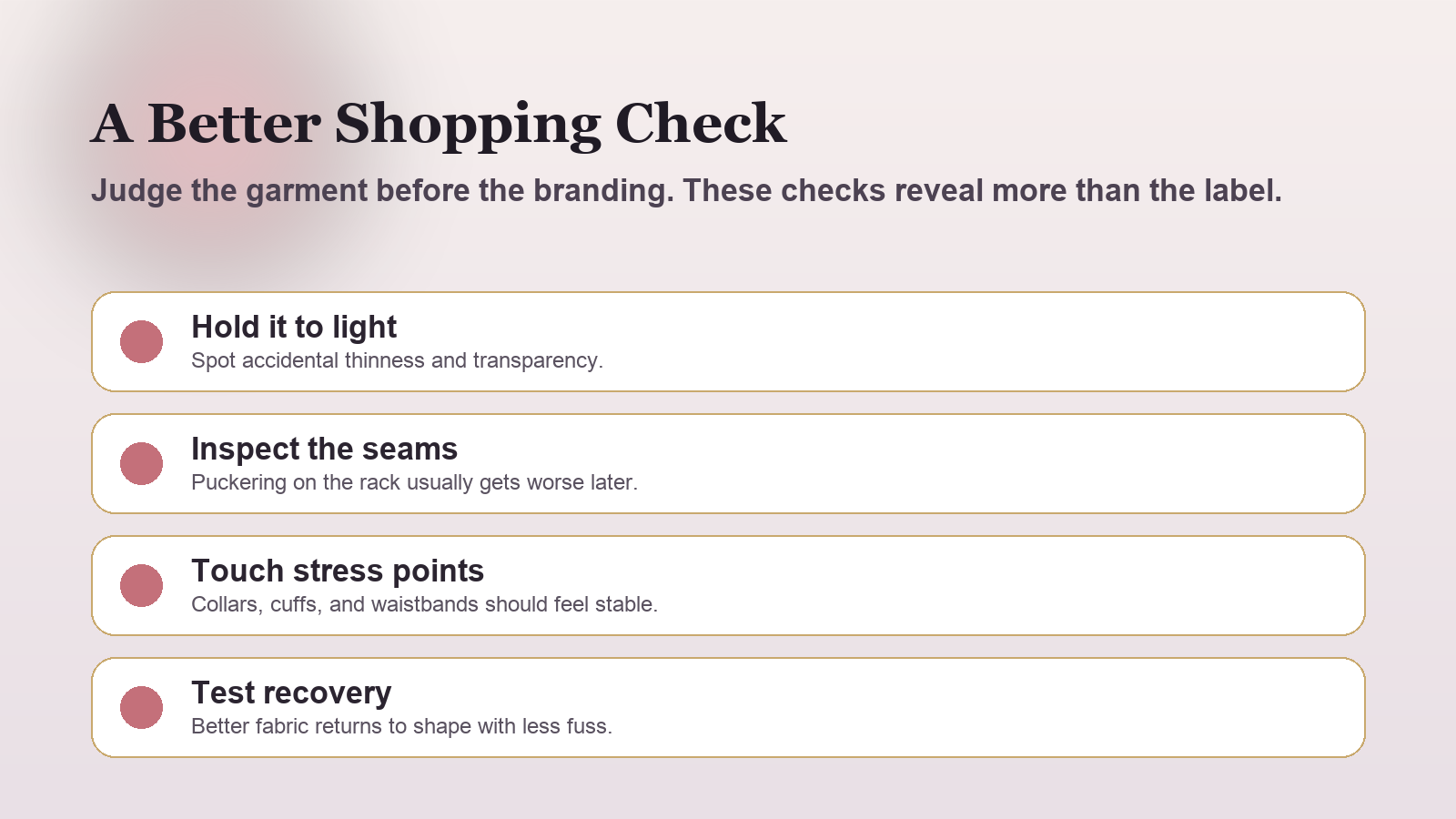
You do not need a fashion degree to judge quality fast. A short physical checklist will tell you more than most product descriptions.
Before you buy, check these:
1. Hold the Fabric Up to Light
Does it go paper-thin immediately, or does it keep some body? Thin is not always bad, but accidental thinness rarely ages well.
2. Look at the Seams
Are they straight and calm, or are they already puckering on the rack? If the seam looks stressed before you wear it, it will not improve at home.
3. Touch the Collar, Waistband, or Cuff
These are stress points. If they already feel loose, limp, or poorly attached, the garment is telling you something.
4. Check Recovery
Gently squeeze or stretch a small area, then let it go. Better fabrics recover with less drama.
5. Ask a Cost-Per-Wear Question
Can you see yourself wearing it ten or twenty times? If not, the lower price may still be the right price. If yes, it may be worth moving up a tier.
Final Verdict
The real difference between fast fashion and mid-range brands is consistency. Fast fashion sells speed and novelty. Mid-range sells a better chance that the item will fit well, wear well, and still feel worth pulling on months from now.
That does not mean you should swear off fast fashion completely. It means you should stop asking every garment to do the same job.
Use fast fashion where speed and novelty matter.
Use mid-range where repetition, fit, and finish matter.
If you apply that filter, your closet usually gets better without getting dramatically bigger.
Before your next purchase, do one simple thing: check the collar, the seam, and the fabric recovery before you look at the brand name. That order will save you more money than most sales ever will.
FAQ
Is fast fashion always lower quality?
Not always. Some pieces are perfectly serviceable, especially for occasional wear. The issue is consistency. You are more likely to see shortcuts in fabric, finishing, or shape retention.
Are mid-range brands always worth the extra money?
No. Some are genuinely better, and some mainly package a stronger brand image. The smart move is to judge fabric, fit, and finishing instead of assuming price tells the whole story.
What items should I avoid buying cheap?
Usually the pieces you plan to wear constantly: denim, black trousers, structured jackets, everyday knits, and shoes or bags that need real support.
What should I buy fast fashion for?
Trend-led items, one-off event outfits, seasonal experiments, and pieces you are not yet sure belong in your long-term wardrobe.